
Here we are in India. Population 1.25 BILLION. China: 1.35 Billion. US: 316 million and Canada: 35 million. Just to keep this all in perspective!
Delhi
is an amazing city…much hustle and bustle and a seething mass of humanity. All
wonderful. It is a modern city that spreads over 1500 sq km. 36 million live in the Greater Delhi area. That is as many as the population of ALL OF CANADA! All cars use compressed
natural gas which has cut down on the gas fumes and overall pollution. 2.2
million use Delhi Metro daily. More and more people are suddenly finding
themselves wealthy here in this city and eager to spend. Mercedes and other car companies
encourage people to lease a second car for 50,000 rupees a month (($1,000.00
Can). They give back the car after 5 years and have enjoyed the prestige of having a second
car.
This
is a land of maharajahs and Mughals. Delhi dates back approximately 5000 years.
After India’s independence in 1947, New Delhi became the capital of the
country. Nehru was the first Prime Minister of the country.
Shah
Jahan was the fifth Mughal Emperor of India. He erected the Jama Masjid which
is the largest mosque in India. It can hold 25,000 devotees in its courtyard.
He also built the Red Fort in Delhi and most significantly, he built the Taj
Mahal (in Agra) to house the tomb of his third wife, Mumtaz Mahal.
The
energy of this spectacular city has to be seen, heard and felt. A Baptist
church, Sikh temple, mosque and MacDonalds all are next door to each other. The
colours, the people…we see none of the squalor which others talk about and are
only conscious of the colourful ladies in their beautiful saris or dresses and the men,
mostly now in western dress but some who dress like Gandhi…the turbans are
glorious.


The
Red Fort has beautiful gardens everywhere. It used to have a moat filled with
crocodiles and snakes to keep out the enemy; these are long gone, thank
goodness! The Royal Family used to reside here. It is made of red sandstone,
hence the title of the place.
We learn that the India that we saw in the movie: "Slumdog Millionaire" was India in the 70's. We see now an India that has emerged radically. It is a whole different world. Alex and I toured Dharavi Slums when we were in Mumbai two years ago. It was a hive of industry with non-stop recycling going on. There was not a pair of idle hands there and it was refreshing. Our politicians would do well to learn about recycling by studying their work.
We learn that the India that we saw in the movie: "Slumdog Millionaire" was India in the 70's. We see now an India that has emerged radically. It is a whole different world. Alex and I toured Dharavi Slums when we were in Mumbai two years ago. It was a hive of industry with non-stop recycling going on. There was not a pair of idle hands there and it was refreshing. Our politicians would do well to learn about recycling by studying their work.
We
hear more about Mahatma Gandhi, father of the nation, who achieved independence
from Britain. Born in 1869, he studied in England and became a lawyer, then
moved to South Africa. It was there that he first experienced the pain of
discrimination while trying to board a train. He was the first coloured
Barrister in South Africa and even though he had purchased the second class
train ticket, he was forbidden to board. He saw great injustice in this and
from then on, took on many cases of racial discrimination. In 1915, he moved
back to India and accomplished the abolishment of the caste system. Sadly, he
was killed in 1948.

Raj
Ghat is a memorial to Gandhi and marks the site where he was cremated in Delhi.
Next we are off to Udaipur in the state of Rajasthan. There are 29 states in India. Rajasthan houses most of the spectacular tourist sights that we will be seeing this trip.
Udaipur is also known as the City of Lakes. It is awash in romance. There are shimmering blue lakes and the scenery is breathtaking. It is also known as Venice of the East. The Best Exotic Marigold Hotel was filmed here, as was James Bond's Octopussy. Rudyard Kipling was inspired by Udaipur many years ago.

We see the City Palace, the largest palace complex in Rajasthan. This was built in 1725 of granite and marble. It stretches over a mile on the lake.

We also see Jagdish Temple, one of the famous temples here. This temple is dedicated to Lord Vishnu. There are three major Gods in the Hindu religion...Brahma, the creator; Vishnu, the Preserver and Shiva, the Destroyer. Shiva is the father of Ganesh, the elephant-headed boy who is the God of Luck and properity. Shiva's wife was the Goddess Parvati. Shiva was away at one time and needed someone to protect her privacy while she bathed. She created a boy and said he would be her son. She brought him to life. He was ordered to keep everyone away from her while she had her bath. Shiva came home unexpectedly and knew nothing of this boy. He did not take kindly to being told he could not visit his wife and severed the head of the boy. Parvati was distraught when she saw what happened and much anguish followed. Shiva told his men to bring him the first live creature they found. They brought an elephant. Shiva placed the head of the elephant on to the body of the boy. Ganesh is the Remover of Obstacles and is honoured at the start of all rituals and ceremonies.

The legend that follows Brahma is that he was attending a vajna (fire-sacrifice) in Pushkar. His wife, Savitri, could not be present at the time so Brahma married another girl. Savitri was furious and placed a curse on Brahma vowing that he would never be worshipped. To this day, in all of India, there is only one temple to Brahma and this is in Pushkar.
The legend that follows Brahma is that he was attending a vajna (fire-sacrifice) in Pushkar. His wife, Savitri, could not be present at the time so Brahma married another girl. Savitri was furious and placed a curse on Brahma vowing that he would never be worshipped. To this day, in all of India, there is only one temple to Brahma and this is in Pushkar.
There is a lovely hotel on the lake called Lake Palace, a Taj Hotel. It is behind me in this picture.

There are SO many legends here. Indian mythology never ends and the stories are delightful. One person's myth is another's religion and close to one billion people keep these stories and beliefs close to their heart. There are rituals and ceremonies that are endless.
A boat ride on Lake Pichola and we are all hooked on this magnificent city, population 600,000, which at one time was the capital of India. The beauuty of the lake is mesmerizing.

We see Sahelion ki Bari Gardens built by Maharana Sangram Singh in 1720. This was built for the 48 ladies that accompanied the princess as part of her dowry. The gardens are adorned by pools, lawns and fountains. the theme is the Monsoon and you can stand with your eyes closed and listen and imagine you are in a heavy rainfall. It is magnificently done.
We drive from city to city with our very excellent guide, Nitin. He is clever, well-spoken and very amusing so travel time flies by quickly. Our tour has been all arranged by GOWAY TRAVEL in Toronto. They are wonderful and hotels are excellent. This was booked by Vision Travel in Toronto (Liz Gibb) and the attention to detail by GoWay is excellent.
We learn more about life in India as we travel...
We learn about Hubble Bubble that men gather around to enjoy...a hookah with a pipe that bubbles tobacco through water with tobacco which gives a good kick.

We hear too about panchyats. This is a system of self-government that exists in India. The word panchyat means assembly. A group of respected elders is chosen by the local community and they settle disputes in their respective villages.
We learn about arranged marriages versus love marriages and it is all very interesting. There is no evidence that the western way works better, that's for sure. Here in India, families move in with the groom's family and all generations live together. They have no need for seniors' homes as families take care of their elderly parents. We learn too that kings and maharajahs could have many wives. I am reminded of Alex who always says: " Ten wives means ten mothers-in-law!"
JODHPUR: On our way to our next destination, Jodhpur, we stop at the amazing Temple of Ranakpur. This is a Jain Temple.
Hinduism is believed to be the very oldest religion on earth. Three other religions have developed out of Hinduism and are their own separate religions:
Jainism
Buddhism
Sikhism
Jains believe that one must never hurt anyone, thus one cannot even take a leather wallet into their temples as, in their view, one should never kill an animal.



We see Sahelion ki Bari Gardens built by Maharana Sangram Singh in 1720. This was built for the 48 ladies that accompanied the princess as part of her dowry. The gardens are adorned by pools, lawns and fountains. the theme is the Monsoon and you can stand with your eyes closed and listen and imagine you are in a heavy rainfall. It is magnificently done.
We drive from city to city with our very excellent guide, Nitin. He is clever, well-spoken and very amusing so travel time flies by quickly. Our tour has been all arranged by GOWAY TRAVEL in Toronto. They are wonderful and hotels are excellent. This was booked by Vision Travel in Toronto (Liz Gibb) and the attention to detail by GoWay is excellent.
We learn more about life in India as we travel...
We learn about Hubble Bubble that men gather around to enjoy...a hookah with a pipe that bubbles tobacco through water with tobacco which gives a good kick.
We hear too about panchyats. This is a system of self-government that exists in India. The word panchyat means assembly. A group of respected elders is chosen by the local community and they settle disputes in their respective villages.
We learn about arranged marriages versus love marriages and it is all very interesting. There is no evidence that the western way works better, that's for sure. Here in India, families move in with the groom's family and all generations live together. They have no need for seniors' homes as families take care of their elderly parents. We learn too that kings and maharajahs could have many wives. I am reminded of Alex who always says: " Ten wives means ten mothers-in-law!"
JODHPUR: On our way to our next destination, Jodhpur, we stop at the amazing Temple of Ranakpur. This is a Jain Temple.
Hinduism is believed to be the very oldest religion on earth. Three other religions have developed out of Hinduism and are their own separate religions:
Jainism
Buddhism
Sikhism
Jains believe that one must never hurt anyone, thus one cannot even take a leather wallet into their temples as, in their view, one should never kill an animal.
At one
point in India, kings adopted Buddhism. Buddha was born in India (that part of India is now Nepal). The religion should thus have spread like wildfire but
then Hindus modified their religion so that rules were more relaxed. Today,
there are very few Buddhists in India (8% of the population) and Hinduism is
the prevalent religion at 78%. Muslims make up 14% of the population.
Off and away to Jodhpur. Ahh, the history of these cities, the forts, the palaces, the temples, the lakes, the architecture and incredible design or the carvings that all date back thousands of years. We have nothing that comes close in North America.
Jodhpur is known as the Blue City. It is the largest city in Rajasthan after Jaipur.
Brahmins were considered the purest of Indian castes. They
housed themselves in blue homes to differentiate themselves from the members of
other castes. Despite the weakening of the caste system, the tradition of blue
homes remains to this day.
In Jodhpur, we see the majestic Meherangarh Fort built by Maharaja Rao Jodha in 1459. The fort rises 400 feet above the city and has very thick walls. Inside are several palaces and large courtyards.
At the start of construction, the hill had one sole occupant, a hermit. He was so angry at being displaced that he placed a curse on the project..."May your citadel ever suffer a scarcity of water." To this day, the city suffers a drought every 3-4 years.

Up to the mid 20th century, palanquins were the popular mode of transportation for royal and noble ladies. This carriage carried the lady within. Automobiles have replaced this decadent way of travel!
Up to the mid 20th century, palanquins were the popular mode of transportation for royal and noble ladies. This carriage carried the lady within. Automobiles have replaced this decadent way of travel!
On descent from the Fort, we see Jaswant Thada, a white marble memorial. This is built out of intricate sheets of marble which are so thin and polished that the sun actually shows through. There are exquisitely carved gazebos here, a multi-tiered garden and a lake.
Our next adventure is in Pushkar, the sacred town for the Hindus. the streets of this town are lined with delightful booths of merchants selling inexpensive treasures. This is the only town with a temple to the God Brahma so we go to visit this. It is a very small temple.
A man approaches me on my way back to the hotel and takes me for a private ritual by the lake where I am blessed and say prayers to Brahma and Vishnu and for my cousins, uncles, brothers, husband and children. I throw flower petals and a coconut off into the lake and then find out that the fee is pretty steep. I give the man what I think the experience was worth and he is not terribly impressed but it is all fascinating and off I go.
A man approaches me on my way back to the hotel and takes me for a private ritual by the lake where I am blessed and say prayers to Brahma and Vishnu and for my cousins, uncles, brothers, husband and children. I throw flower petals and a coconut off into the lake and then find out that the fee is pretty steep. I give the man what I think the experience was worth and he is not terribly impressed but it is all fascinating and off I go.
There are monkeys everywhere...
On the way home, I get butted in the head by a bull. I was taking pictures and thought he would go around me...wrong again! It all gives new meaning to "Holy Cow" as there are cows all over the street everywhere we go. Cows are sacred in India so traffic drives around them. It is against the law to kill a cow. Cows are used to provide milk, work on the farm, their dung is used to plaster huts and their hides are used (after their natural death) to provide leather.
A young boy comes up and says: "Chapati?" I know this is food and I assure him I have had dinner...he persists and lets me know that this is for him, not me. I gave this a moment's thought and decided that I could buy him a chapati but certainly would not give him any money. Off we went and finally reached the chapati stand. All of a sudden, he wants chapati butter not a chapati so I buy that for him and make sure the package is opened so he cannot return it and get the money. (I was not endeared to this young boy.) Now he also wants some flour with which to make the chapati. The shop owner assures me this only comes in 10 kg portions. Well, there is a sucker born every minute and I am no exception so I buy 10 kg of flour. I have to wait 10 minutes while it is fetched and weighed but I want to make sure that if this is a scam, then the store owner will at the very least suffer some inconvenience.
Live and learn and then I return to the hotel, having instructed this young man that he must get to school and NOT live on the street. I also preach dental hygiene as his teeth are clearly having serious trouble.
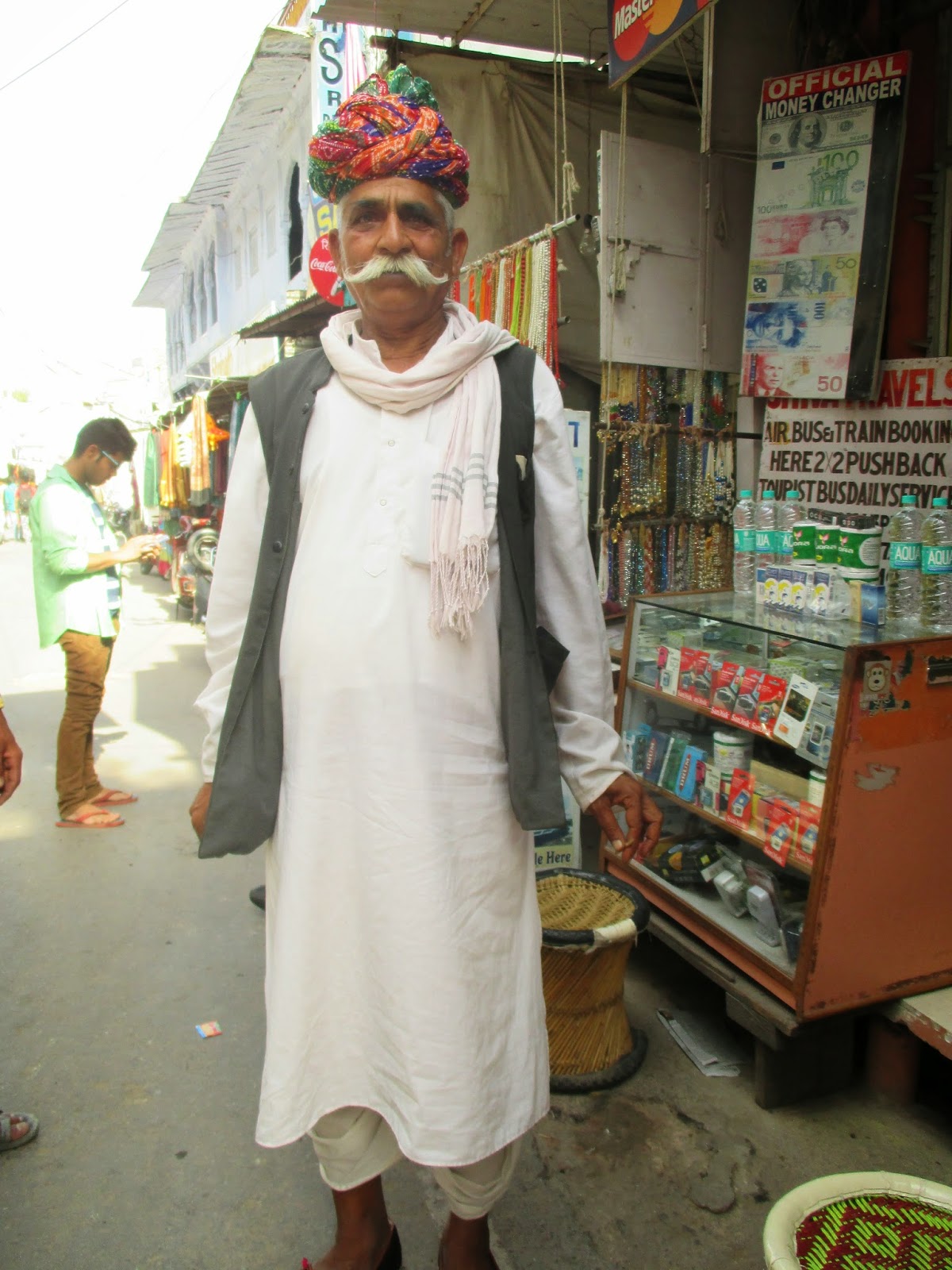
Along the way, I meet this lovely man and we chat for ages. He is a treasure and wants nothing but to exchange happy thoughts. I promise to mail him some pictures of Canada by post. The moustache is a work of art.
Back to the hotel for a massage. All of SE Asia and India have massages for next to nothing. It is the way I was born to live.
This is the view from our hotel at night. We are right on the water.

This is the view from our hotel at night. We are right on the water.
Next stop: Jaipur. Also known as the Pink City. The pink color has its own history. In 1876, the
Prince of Wales (Albert) and Queen Victoria visited India on a tour. Since pink denotes
the color of hospitality, Maharaja Ram Singh of Jaipur painted the whole city
pink in color to welcome the guests. The tradition has been followed
by the residents who, if they live in the old city, must have a pink house.
We visit the Amber Fort/Amber Palace. In India, no one distinguishes between sheep and goats or forts and palaces. There seems to be much overlap and too much detail would be overwhelming so we are happy to just enjoy the magic. The ornamentation is truly spectacular. There are halls of mirrors and marble everywhere. Frescoes and paintings adorn all. Then we are off to the City Palace. It is too simple a name for a structure this grand and impressive.
We visit Jantar Mantar, translated as Calculation Instrument. This observatory was built between 1728 and 1734 by Maharajah Jai Singh. Here is the largest sun dial in the world and many enormous astrological instruments. Once a year, a local astrologer makes predictions for the following year that are often 75% correct regarding weather and such things as rainfall. For 2014/2015, to date, he has been 100% correct. We are told that in 2015, there will be a lot of rainfall in August but not before or after. Lucky us, the weather has been glorious. Perfect temperatures and clear blue skies. The instruments are extremely impressive and on a very large scale. The creators of this were men so ahead of their time.
We learn that movie houses play an important part in street culture. Street kids make money recycling and spend some money escaping life to see a movie. Once there, they are not bothered by anyone and can sleep or watch a movie or sniff glue. They also all have a good outfit in which they can get dressed up and then crash a wedding. Since there are 600-700 at the wedding, once dressed up, no-one notices that they do not belong and they enjoy the food and the fun at the wedding!
Check out this picture...what do you think this is? Looks rather like a necklace maybe? It is a long circular staircase taken at a clever angle by one of the members of our group.
At the City Palace in Jaipur, we learn that the gowns worn by ladies could weigh up to 40 kg. They were so heavy that ladies had to be carried around in wheelchairs as they could not walk. The outfits of days gone by are really something to behold.
Stay tuned...we are off to Sawai Madhopur, home to Ranthambore National Park where we will have two game drives. Tigers are usually spotted here so here's hoping.
At the City Palace in Jaipur, we learn that the gowns worn by ladies could weigh up to 40 kg. They were so heavy that ladies had to be carried around in wheelchairs as they could not walk. The outfits of days gone by are really something to behold.
Stay tuned...we are off to Sawai Madhopur, home to Ranthambore National Park where we will have two game drives. Tigers are usually spotted here so here's hoping.

.JPG)
.JPG)


.JPG)
.JPG)

.JPG)

.JPG)
.JPG)
.JPG)


